Christmas: The Only Holiday That Takes a Whole House
Six weeks, four rooms, two different dinner tables and a calendar that does not agree with itself. Where Christmas falls in different countries, what gets decorated where, and the order to buy it in.
Every other occasion in the calendar is a day. Christmas is a season, and that single difference changes every decision about decorating it. A Halloween scheme goes up in an evening and comes down on the first of November. A Christmas scheme is lived with for five or six weeks, in every room, in the dark, under artificial light, by people who are in the house far more than usual. Anything irritating becomes very irritating by the third week.
It is also the only occasion that has two separate dinner tables in most households, an outdoor display and an indoor one, and a gift-wrapping operation that is itself a decorating job. Our Christmas and winter shelf currently holds 40 pieces, and it is the most varied in the range for exactly that reason.
One holiday, several calendars
Christmas is not kept on the same day everywhere, and in a good many places the twenty-fifth of December is not even the main event. The differences are not trivia: they decide which night the table is laid for, which is the only question that matters when you are deciding what to buy.
| Where | The main night | What happens | Which table is decorated |
|---|---|---|---|
| United States, Canada | 25 December | Morning gifts, a large midday or afternoon meal, stockings | Christmas Day lunch, plus a lighter Christmas Eve |
| United Kingdom, Ireland | 25 December | Midday meal, crackers, then Boxing Day on the 26th | Christmas Day lunch, with the table often left set for the 26th |
| Germany, Austria, Poland, Czechia | 24 December | Heiliger Abend or Wigilia: gifts and the main meal on Christmas Eve | Christmas Eve, and it is the formal one |
| Spain, Portugal, Latin America | 24 December | Nochebuena: a late family dinner, often after midnight | Christmas Eve, late and long |
| Italy | 24 and 25 December | A fish dinner on the Eve, a large lunch on the Day | Both, in that order |
| Netherlands, Belgium | 5 or 6 December, then 25 | Sinterklaas carries the gift-giving; Christmas is the quieter meal | Two occasions three weeks apart |
| Sweden, Norway, Denmark | 24 December | Julafton: the julbord and the main meal on the Eve | Christmas Eve |
| Russia, Serbia, Ethiopia, parts of the Orthodox world | 7 January | The Julian-calendar Nativity, after a fasting period | Early January, after New Year |
| Spain, and much of Latin America again | 6 January | Epiphany and the Three Kings, with gifts for children | A second table in January |
Two consequences for anyone buying decorations. First, if the main meal is on Christmas Eve then it is an evening, candlelit, indoor table, and a dark runner with metallic detail will outperform a bright red printed cloth that was designed for daylight. Second, in households that keep both an Epiphany and a Christmas table, or a Julian-calendar Christmas after New Year, decorations need to survive being up for six weeks rather than two, which rules out anything paper in a high-traffic spot.
The only question that decides what to buy is which night the table is laid for. Everything else follows from that.Christmas Eve or Christmas Day
Why evergreen, and why December
Almost every element of a decorated Christmas room predates the holiday it belongs to, which is worth knowing because it explains why the visual language is so stable across countries that agree on very little else.
Midwinter festivals are older than any of it. The solstice is a real astronomical event that a farming society cannot ignore, and northern Europe marked the turn of the light with fire, feasting and greenery long before the fourth century, when the Church settled the Nativity on the twenty-fifth of December. Roman Saturnalia sat in the same week, with its gift-giving and its inverted household order. Bringing evergreen indoors at the point when everything else outside is dead is one of those gestures that needs no explanation in any culture: holly, ivy, fir and mistletoe all kept their colour when nothing else did, and that was the whole point.
The decorated tree itself is a German tradition, documented from the sixteenth century in the Rhineland and spread through German-speaking Europe over the next two hundred years. It became British and then American in the middle of the nineteenth century, largely through the royal household: an engraving of Victoria and Albert around a decorated tree, published in 1848, did more for the format than any number of sermons. German emigration carried the same custom directly into Pennsylvania and the American Midwest at roughly the same time.
The rest of the modern kit is Victorian and commercial. The printed Christmas card dates from 1843, the same year as the Dickens novella that fixed the holiday's sentimental register in English for good. The red-suited Santa consolidated in nineteenth-century American illustration, well before the advertising campaigns usually credited with inventing him. The wrapped-parcel pile under a tree, which this piece treats as a decorating layer in its own right, is essentially a twentieth-century development that followed cheap printed paper.
What survives from all of it, and what a decorating scheme is really working with, is a short list: light in the dark, green where there should be none, red as the contrast colour, and a pile of wrapped things that grows. Every register discussed further down is a variation on those four.
The scale problem
Christmas is the only occasion where the decorated area is the whole house rather than one surface, and the usual budget mistake follows directly. People spend nearly all of it on the tree, which is one object in one corner, and leave four other zones untouched.
| Zone | How long it is looked at | Format | Roughly, on our shelf |
|---|---|---|---|
| Front door and porch | Every arrival and departure, six weeks | A wreath or a hanging sign, plus vertical porch banners | $10 to $20 |
| Path and yard | From the street, in the dark | A garden flag on a stand; lighting bought locally | $6 |
| Mantel or main wall | All evening, every evening | A letter banner, garland, stockings | $6 to $10 |
| Sofa and soft furnishing | Sat on, every day | Cushion covers over existing inserts | $10 |
| The dinner table | Two or three long meals | A runner or a cloth, plus low centre pieces | $6 to $17 |
| The gift pile | Growing in the corner for weeks | Paper, tags, ribbon: a decorating layer in its own right | $8 to $16 |
Nearly all of the budget goes on the tree, which is one object in one corner, and four other zones are left untouched.Where the money actually goes
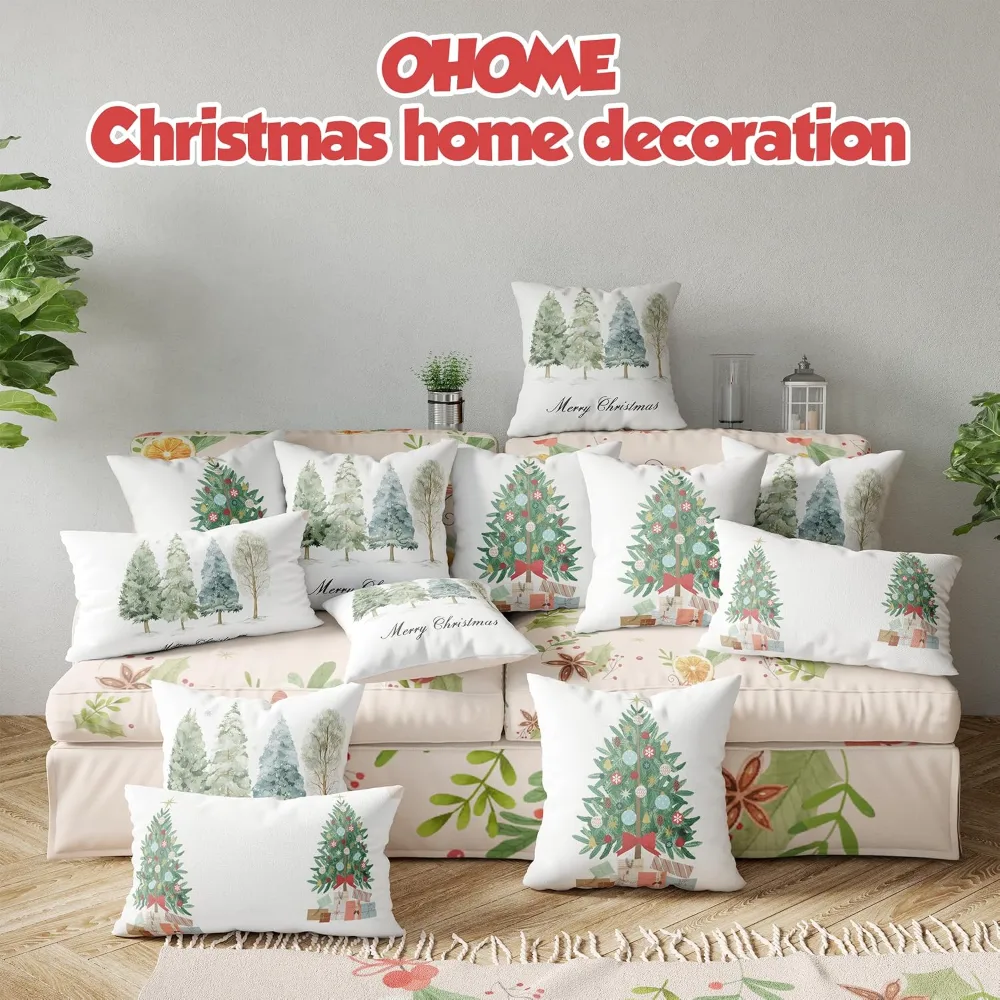
Cushion covers are the underrated line in that table. They swap over inserts you already own, they change the room's colour more than anything else at that price, and they store as flat fabric rather than as objects. For a room that has no mantel and no space for a second tree, they are the whole scheme.

Covers over your existing 18-inch inserts: the largest colour change per dollar in the whole range, and they fold to nothing in storage.
The door and the porch
The exterior is where Christmas decorating is most visible and where the weather does most damage. Three formats are worth knowing.
The wreath
Still the most effective single piece, and the one with the oldest logic behind it: a circle of evergreen on the door at midwinter is a good deal older than the holiday it now belongs to. Hang it on a wide flat ribbon over the top of the door, or on an over-the-door hook sized for an exterior leaf, which is about 1.75 inches thick in American construction. Magnetic hooks hold well on steel doors and not at all on fibreglass or wood, so test with a fridge magnet before buying one.

A printed wooden round rather than a foliage wreath: it survives rain, it does not shed, and it comes out of the box flat in six years' time.
Porch banners
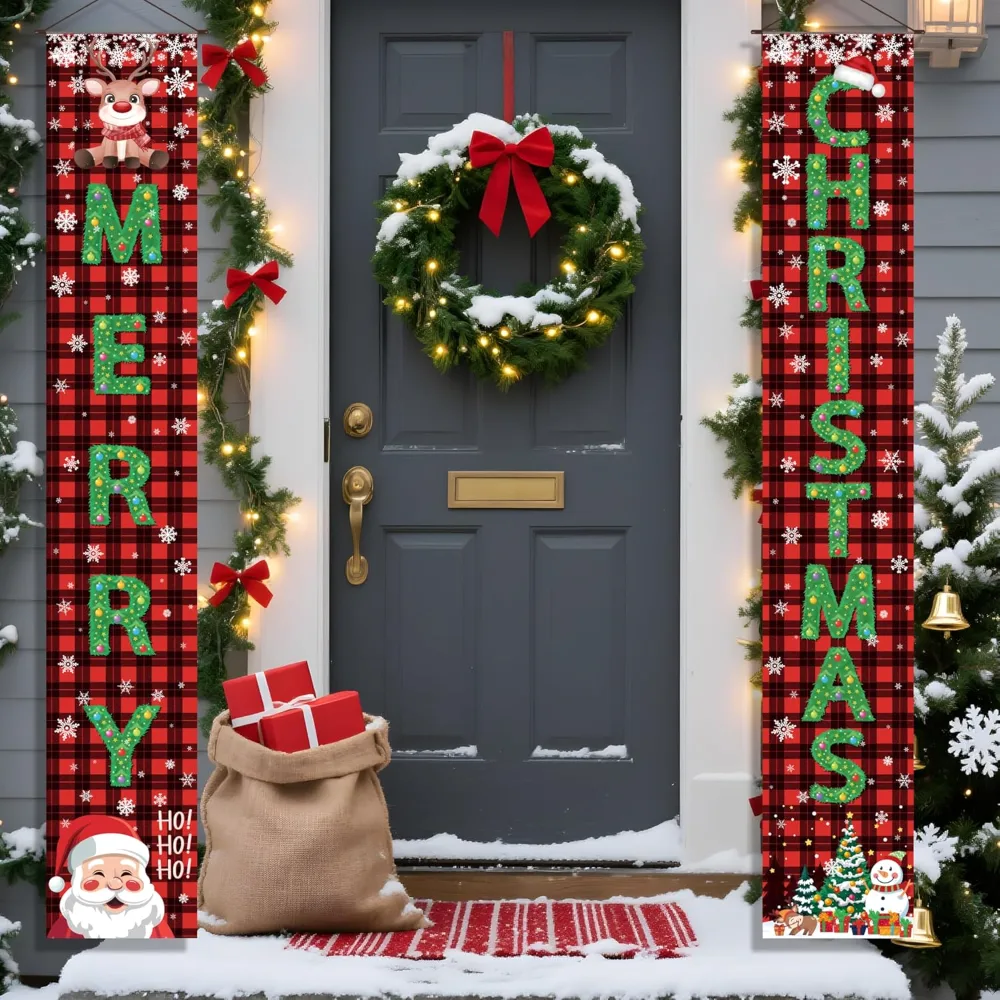
The vertical pair hung either side of a front door is a North American format that has spread quickly, and it is the single strongest exterior effect for the money. Two long printed panels turn an ordinary doorway into a framed entrance, and they take about a minute to hang on the standard grommets.

A pair of vertical panels either side of the door: the cheapest way to make a house read as decorated from the pavement.
The garden flag
The same 12 by 18 inch standard as every other occasion, on the same stand you already own. In snow, set the stand before the ground freezes rather than after.

One flag, one stand, and it is the fourth occasion of the year that stand has carried. That is what makes the stand worth buying properly.
Mantel, wall and window
Indoors the mantel is the natural focus because it is a horizontal shelf at eye height in the room where people sit. If the house has no fireplace, the same job is done by the top of a bookcase, a sideboard, or a line across the wall above the sofa.
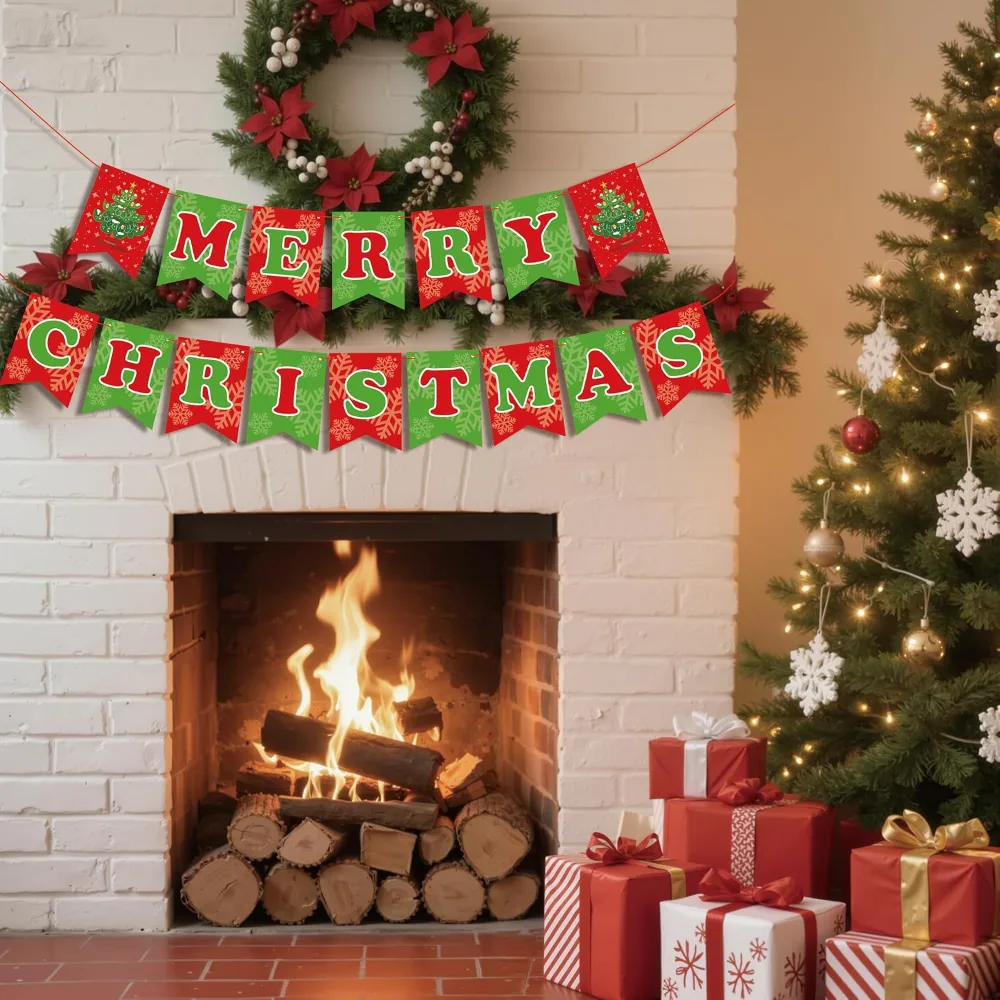
The composition that works is not complicated. A horizontal line, something with height at one or both ends, and something soft trailing over the front edge. A letter banner supplies the line, and it is worth matching the letter height to the room: about one inch of letter for every three to four feet of viewing distance, which puts a standard five-inch banner at about twenty feet, or the length of an ordinary living room.

The horizontal line, in the size that suits a living room rather than a hall. Everything else on the mantel arranges itself under it.
Two details that make the difference between a mantel that looks arranged and one that looks piled. Work in odd numbers, because three objects group and four line up. And keep everything on the mantel shorter than the widest thing on it, so the eye reads one shape rather than five competing ones.
Windows are the other indoor surface, and the one most visible from outside. Clings go on the inside of the glass, applied to a surface cleaned with alcohol rather than a spray cleaner, since it is the residue from most sprays that stops them holding. Cold glass holds them badly, so warm the cling in your hands first.
Two tables, one holiday
Most households that keep Christmas properly lay two tables: a lighter one on Christmas Eve and the main one on Christmas Day, or the other way round depending on which country's habit they follow. They want different things.
| The evening table | The daylight table | |
|---|---|---|
| Typical night | Christmas Eve, or Nochebuena, or Julafton | Christmas Day lunch |
| Light | Candles and lamps, low and warm | Daylight from a window, flat and even |
| What works | A dark runner, metallic detail, height from candles | A printed cloth, strong colour, pattern that holds up in flat light |
| What fails | Bright printed plastic, which goes shiny under lamps | Dark navy and deep green, which go muddy in daylight |
| Centre | Candlesticks, which are the one thing allowed above eye level | Low pieces under about twelve inches, or the food itself |
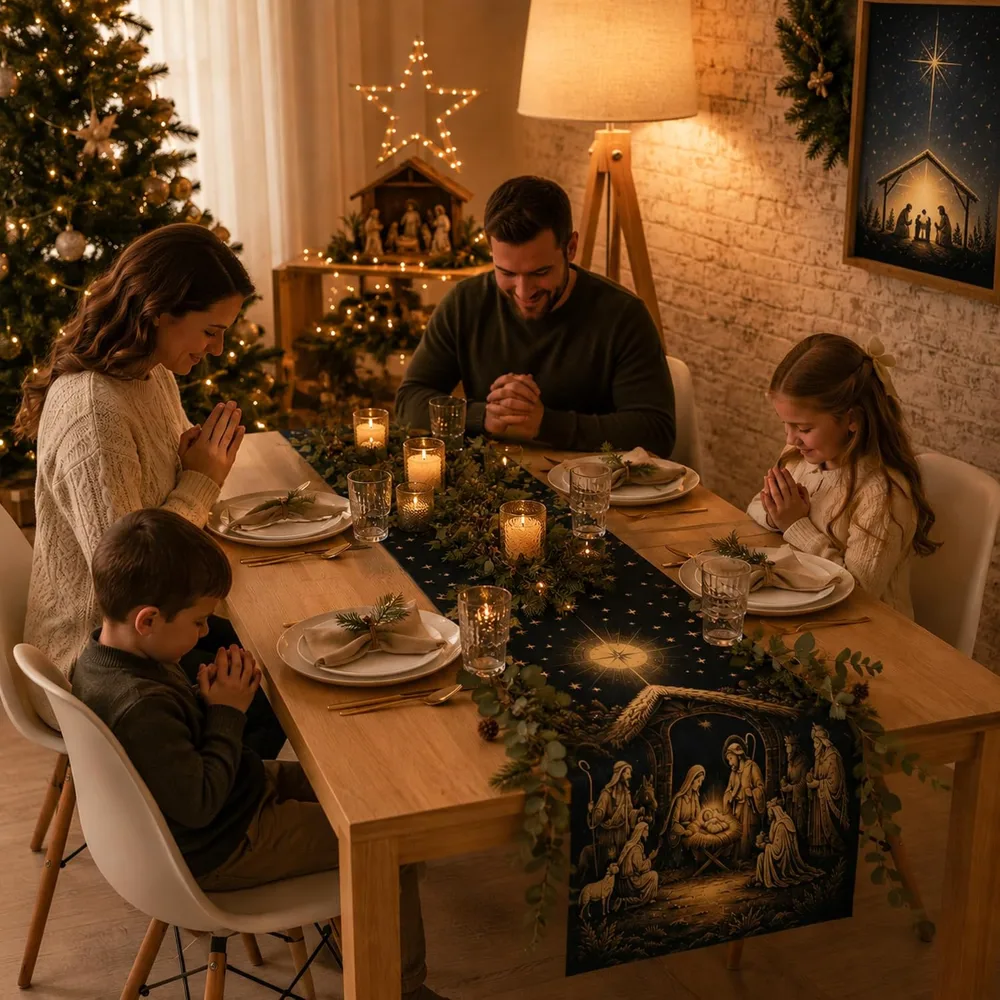
The runner is the piece that solves the evening table, because it leaves the wood showing at the edges and the wood is what carries candlelight. Our nativity runner is deliberately dark for that reason, and it is the piece that photographs best of anything in the range under candles.

A dark runner for a candlelit table. Leaves the wood showing at the edges, which is where the light lands.

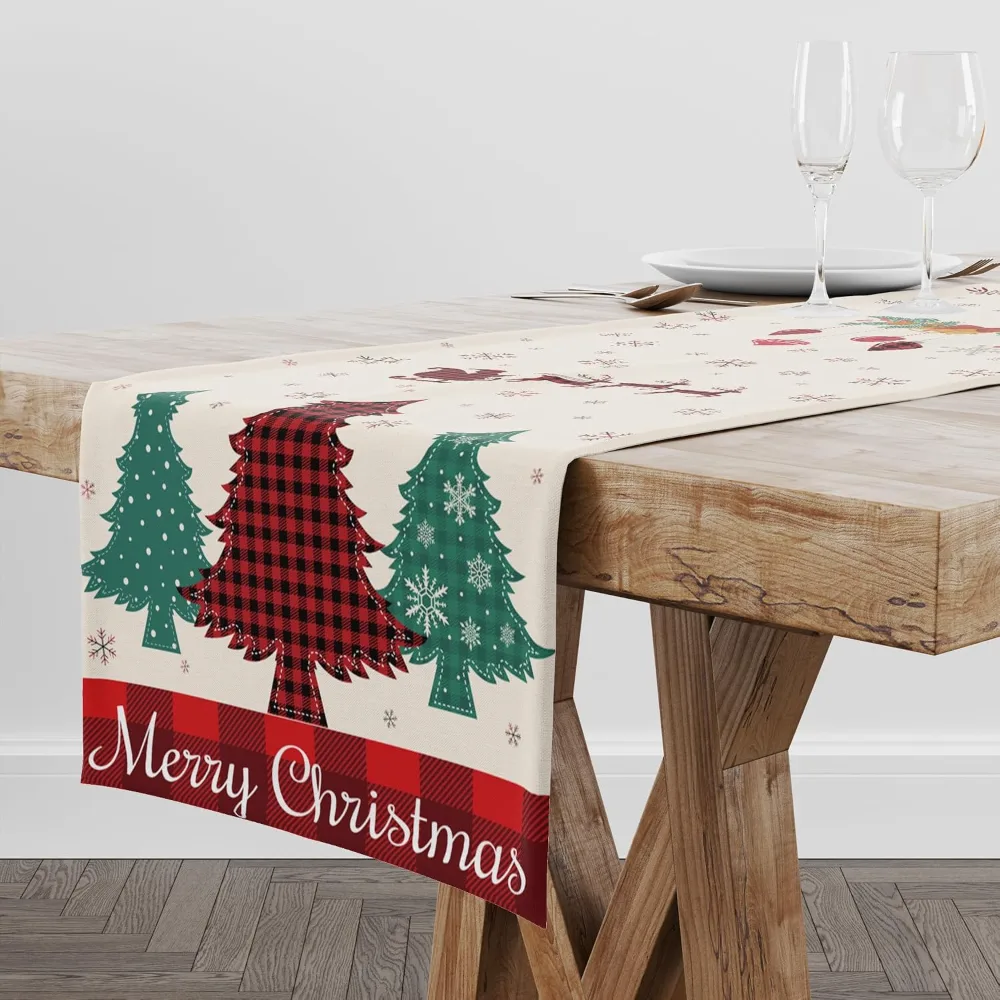
The daylight alternative in the same format: red plaid and trees on a light ground, which holds its colour under flat window light.
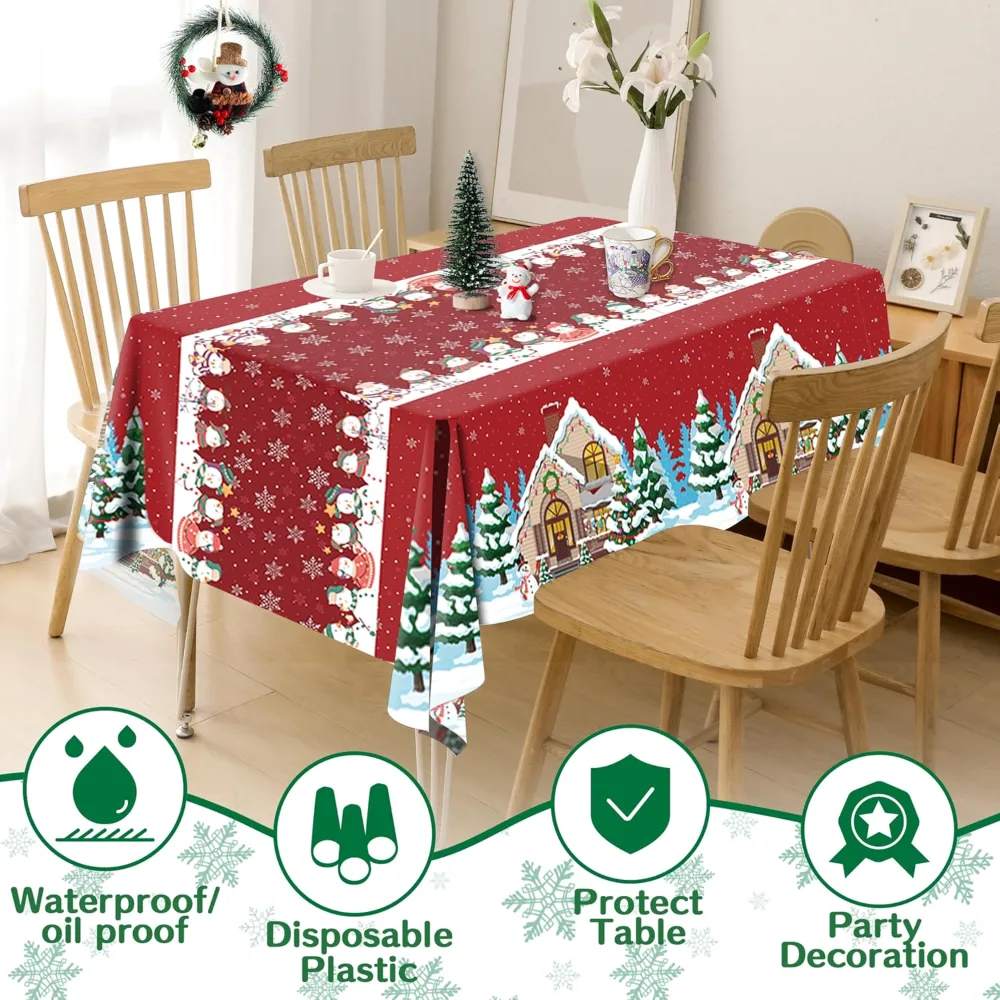
Sizing, as ever, comes from the table rather than from the box. Add twelve inches to the table length for a runner, or twice your chosen drop to both dimensions for a cloth. The size guide covers it and the home page calculator does the arithmetic.
The tree, and the six feet around it
We do not sell trees, and this is the one part of the room where the useful advice is about what surrounds the tree rather than what goes on it.
A decorated tree is a tall, bright, extremely busy object, and it swallows anything placed within about six feet of it. Small decorations near a tree simply disappear, and that is how so many rooms end up with a beautifully dressed tree standing in an otherwise flat space. The two things that survive that proximity are large flat surfaces and floor-level colour.
- The wall behind and beside it. Whatever goes here has to be big and simple. A long banner works, a cluster of small pieces does not.
- The floor. The skirt, the parcels and anything at ankle height read clearly, because the tree does not compete down there. This is why the wrapped pile matters visually as well as sentimentally.
- The seating. Cushion covers on a sofa six feet away pick up the tree's colours and carry them across the room, which is the cheapest way to stop the tree looking like an object standing on its own in a corner.
The corollary for a room with no tree, which includes a great many flats, a guest room and most rented accommodation: the mantel or the wall has to do the entire job, and it can. A banner, a garland along a shelf and two cushion covers produce a decorated room without a single needle in the carpet, for under twenty dollars. That combination is on the Christmas shelf and it is the one we would build first in a small space.
Three visual registers, and not mixing them
Christmas has more distinct visual languages than any other occasion, and most rooms that look wrong are rooms running two of them at once.
| Register | Colours and motifs | Where it belongs | Fights with |
|---|---|---|---|
| Traditional | Red and green, holly, plaid, gingerbread, Santa | A family house with children, a daylight lunch table | Anything blue or silver |
| Nordic | Red and white, natural wood, wheat, simple trees | A smaller room, a quiet scheme, natural materials | Bright multicoloured lights |
| Devotional | Deep blue, gold, nativity, candlelight | An evening table, a Christmas Eve meal | Cartoon snowmen |
| Winter and New Year | Blue, silver, white, snowflakes, no religious motif | A scheme that stays up into January | Red and green together |
That last row is more useful than it looks. A blue-and-silver winter scheme is not really a Christmas scheme, which is exactly its advantage: it can go up in early December and stay up through New Year without looking like a house that forgot to take the decorations down. Our shelf carries the New Year pieces alongside the Christmas ones for that reason.
If you want a mixed scheme anyway, the way to do it without a collision is to let one register own the public rooms and the other own a single space. Traditional downstairs, Nordic in a bedroom, for instance. What does not work is one of each on the same mantel.
The gift pile is a decorating layer
For most of December the largest decorated object in the room is not the tree, it is the pile under it, and it is the only one that grows. Treating wrapping as decoration rather than as packaging is the cheapest upgrade available to a Christmas room.
Three components, and the maths on each:
- Paper. Two or three patterns that share a colour, rather than one pattern or six. A pile in matched paper reads as a designed object; a pile in mismatched paper reads as a heap.
- Tags. The item that always runs out. A household wrapping for an extended family gets through more than expected, and that is the reason they are sold in packs of several hundred rather than in tens.
- Ribbon. The finish that takes a wrapped parcel from acceptable to deliberate, and the one component that costs almost nothing per gift.

Five hundred tags sounds absurd until the first year you run out on the twenty-third. This is the pack size the category actually needs.

Four rolls, which is roughly a hundred parcels finished properly, for the price of two greeting cards.
One practical habit: wrap in batches by recipient rather than by day, and write the tag before the parcel goes on the pile. Unlabelled parcels are the reason people unwrap things on the twenty-fifth to find out whose they are.
Stockings, stickers and the cookie afternoon
The children's Christmas has its own set of objects, and most of them are activities rather than decorations. That is deliberate: the long run-up to Christmas is the problem the category solves.
- Stocking fillers. Sticker sheets and scratch-paper packs have replaced a good deal of what used to go into a stocking, mainly because they take up space cheerfully and survive being sat on.
- Cookie cutters. The single most reliable December afternoon there is. Shaped cutters turn an ordinary batch of dough into an activity with a result.
- Bingo and card games. The thing that works when the extended family arrives and the age range is four to seventy.
- Colouring covers. The same trick as at Thanksgiving: the tablecloth is the entertainment, and it is thrown away with the mess on it.

Nine shapes, and the only Christmas purchase on this page that produces something edible at the end of the afternoon.

Three hundred and twenty stickers is a fortnight of a five-year-old's attention for the price of a coffee.

The same room, a different night
The week between Christmas and New Year is awkward for a decorated house. The Christmas scheme has been up for a month and is starting to look tired, and there is one more party to hold in the same room.
The efficient answer is to build the December scheme so that a small swap converts it. Take down the specifically Christmas lettering, leave the lights, the greenery and anything blue, silver or white, and add one new banner. The room reads as a different occasion for the price of a single piece.

One banner is the whole conversion: the room stays as it is and the lettering changes the occasion.
Our shelf keeps the New Year pieces on the Christmas and winter page rather than on their own, precisely because households buy them in the same order. The same logic covers the Lunar New Year pieces in the range, which fall several weeks later again and belong to a different set of households entirely.
The long season
Christmas has the longest buying window of any occasion and people still leave it too late, because the window closes gradually rather than suddenly. There is no day on which Christmas stock disappears; there is a long slope on which the good patterns go first.
- Late October and early November. The best window. Full stock, ordinary prices, and no delivery pressure. Anything you want to match across several pieces should be bought here, in one order, from the same print run.
- Mid to late November. Still comfortable, and the point at which most households start. Note that this is the same fortnight as Thanksgiving in the United States, so the order goes in alongside the Thanksgiving one.
- The first fortnight of December. Workable, with gaps appearing in popular patterns and delivery windows lengthening.
- After the fifteenth of December. A gamble on anything that has to arrive by a fixed date.
- The twenty-seventh onwards. The cheapest decorations of the year, and the right time to buy printed indoor pieces for next December.
Our order calendar keeps this against today's date, and the Christmas shelf shows how far away the date currently is.
Taking it down
Tradition puts the end of Christmas at Twelfth Night, which is the fifth or sixth of January depending on which counting you follow, and the superstition that it is unlucky to leave decorations up past it is old enough to be worth honouring purely for the reminder. Households on the Julian calendar are of course only reaching the twenty-fifth of December at that point, which is a good illustration of how little any of this is universal.
The storage rules are the same as for the rest of the range, with one addition specific to December.
- Roll printed pieces, never fold them. A cardboard tube keeps a runner crease-free indefinitely; a fold puts a permanent white line across the print.
- Dry everything, especially anything that has been outdoors. A wreath boxed damp in January is a wreath with mildew in November.
- Cushion covers come off the inserts. They store as flat fabric in a bag rather than as four cushions taking a shelf.
- Keep the leftover tags and ribbon with the decorations, not in a drawer. They are the thing you will otherwise buy again in December while the previous pack sits somewhere in the house.
The care and storage page covers washing by material. And as with the other occasions, a note in the box about what you were short of is worth more next December than any reminder set on a phone.
A whole house in six purchases
Building a Christmas scheme from nothing, in the order that gives the most visible change for each step:
| Order | Piece | What it does | Roughly |
|---|---|---|---|
| 1 | A wreath or door round | The piece every arrival sees, six weeks running | $10 |
| 2 | A mantel banner | Sets the horizontal line that makes the main room read as decorated | $6 |
| 3 | A table runner | Covers both dinner tables and stores as one rolled piece | $6 to $8 |
| 4 | Porch banners | The strongest exterior effect for the money, from the pavement | $10 |
| 5 | Cushion covers | The biggest colour change in the room, over inserts you own | $10 |
| 6 | Tags, ribbon and paper | Turns the growing pile in the corner into part of the scheme | $8 to $16 |
That is a six-zone house for somewhere around fifty to sixty dollars, and every piece except the wrapping comes out of the box again next year. The full shelf is on the Christmas and winter page, sorted by price, and the party planner covers the table on its own in the same sequence.
Christmas & Winter, sorted by price


The rest of the run
Samhain, guising and trunk-or-treat: where the night is actually kept, what gets decorated in each of the five zones a visitor reads, and which format does the work in each one.
The Thanksgiving Table, Layer by LayerTwo countries keep it on different dates, a third of the guests are children, and everything is decided by one measurement of the table.