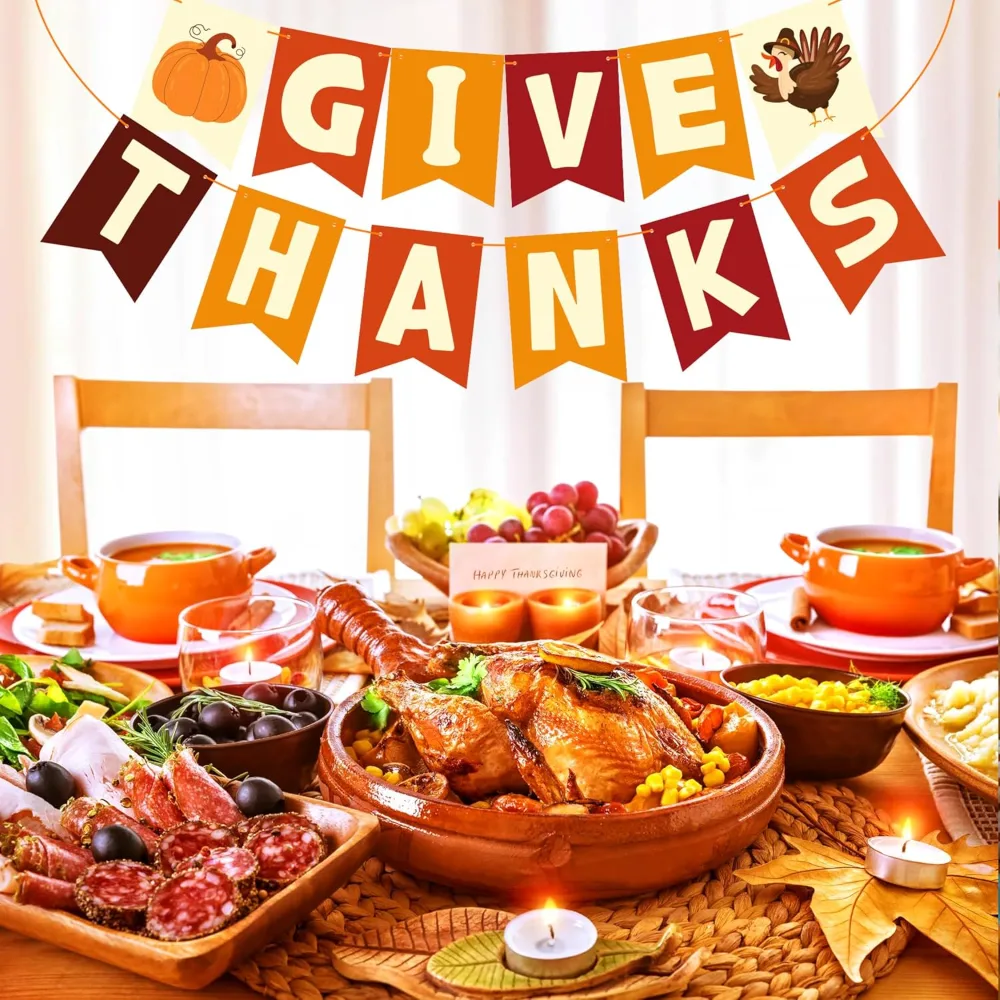
The Thanksgiving Table, Layer by Layer
Two countries keep it on different dates, a third of the guests are children, and everything is decided by one measurement of the table. A working guide to the meal that is decorated inward rather than outward.
Thanksgiving is the inverse of Halloween. Nobody walks past and looks at it. The audience is eight to twelve people who will sit inside the same room for three hours, at a distance of about thirty inches from everything you put on the table, and who will photograph it before they eat it. The decoration is therefore inward-facing, close-range and horizontal, and the money goes on the surface people are actually looking at.
Our own catalogue makes the point without being asked to. Of the 45 Thanksgiving pieces on the shelf, 21 are tablecloths. No other occasion in the range is anywhere near that lopsided. The story runs through where the holiday is kept, what Friendsgiving changed, and how to build the table in the order the layers should be decided.
Two Thanksgivings, and a much older idea
There are two national Thanksgivings in North America and they are six weeks apart. The Canadian one falls on the second Monday of October, which places it at the actual end of the northern harvest and gives it a long weekend. The American one falls on the fourth Thursday of November, a date fixed by Congress in 1941 after a period in which it moved about, and it gives the United States a four-day weekend that has become the largest domestic travel event of its year.
The distance between the dates matters for decorating in a way that surprises people who move between the two countries. A Canadian Thanksgiving table sits in genuine autumn: leaves are turning outside the window and the harvest motifs on the cloth match the view. An American Thanksgiving in late November sits at the edge of winter, three days before the Christmas decorations go up, and a good part of its visual job is to hold the line against that.
The wider idea is much older and nearly universal. Harvest thanksgiving festivals exist wherever there is a harvest, and several of them are considerably older than either North American holiday.
| Where | When | What it is |
|---|---|---|
| United States | Fourth Thursday of November | A seated family meal, roast turkey, four-day weekend, the largest travel event of the American year |
| Canada | Second Monday of October | The same meal at the true end of harvest, treated as a long weekend rather than a national pilgrimage |
| Germany, Austria, Switzerland | Usually the first Sunday of October | Erntedankfest: a church harvest festival with a decorated crown or wreath of grain |
| United Kingdom | Around the September harvest moon | Harvest festival, a school and parish tradition of bringing food to be given away |
| Korea | Eighth lunar month, usually September | Chuseok: travel home, food shared with ancestors, three days |
| Ghana | August and September | Homowo: a yam and maize harvest festival with processions |
| Southern India | Mid-January | Pongal: four days built around the first rice of the harvest, cooked outdoors |
| Liberia | First Thursday of November | A Thanksgiving descended directly from the American one, brought by settlers in the nineteenth century |
What is worth taking from that list is the shape rather than the detail. A harvest meal is decorated with what the harvest produced. The visual language is therefore grain, gourds, leaves and the colours of a field in October, and why it works everywhere without explanation.
How the American date was actually settled
The founding story everyone is taught is the harvest gathering at Plymouth in 1621, shared between the English colonists and the Wampanoag. It is a real event and it is also not the origin of the holiday, because nothing continuous followed from it. Days of thanksgiving were proclaimed irregularly for the next two centuries, sometimes for a harvest and often for something else entirely, such as a military outcome or the end of a drought, and different colonies and later different states kept them on different days.
The person who turned that into a national date was a magazine editor. Sarah Josepha Hale, who edited Godey's Lady's Book and who also wrote the nursery rhyme about the lamb, campaigned for a unified national Thanksgiving for roughly four decades, writing editorials every year and letters to a succession of presidents. She got her answer from Abraham Lincoln in 1863, in the middle of the Civil War, when a proclamation set a national day of thanksgiving for the last Thursday of November. The timing was not incidental: a shared domestic ritual was politically useful in a country that had split in half.
The date then moved once more, and the episode is worth knowing because it explains the odd wording of the modern rule. In 1939 Franklin Roosevelt shifted the holiday a week earlier to lengthen the Christmas shopping season during the Depression. The change was optional by state, so for two years part of the country kept one date and part kept another, and the press called the new one Franksgiving. Congress ended the confusion in 1941 by fixing the holiday on the fourth Thursday of November, which is not always the last one. That is why some Novembers have a Thanksgiving with a whole week still to run afterwards.
Two things in that history still shape what gets bought. The holiday was designed from the start as a domestic, table-centred ritual rather than a public one, and its decorations stayed indoor and small in scale. And its position in the retail year was deliberately set to open the Christmas season. That is the reason the shelf clears the day after, and the reason the sensible plan is to buy for both occasions in one order. The order calendar assumes exactly that.
Friendsgiving changed the shopping list
The newer holiday is Friendsgiving, and it is now large enough to have its own products. It is a Thanksgiving meal held with friends rather than family, almost always on a different day, usually the weekend before the holiday itself, and typically potluck rather than cooked by one household.
Three things about it change what gets bought. It happens in a smaller space, often a flat rather than a house with a dining room. It has no fixed seating plan, because the number of people is not known until an hour beforehand. And it is the more photographed of the two meals by a wide margin, because the guests are the age group that photographs meals.
The practical consequences: disposable covers rather than linen, because nobody is doing laundry for twelve after a potluck. A banner rather than a centrepiece, because a banner works in a room where the food is spread across a kitchen counter and a coffee table. And a wider table than expected, because Friendsgiving tables are usually two tables pushed together, which is exactly the case where a cloth bought to the wrong measurement shows.

A banner rather than a centrepiece is the right first purchase for a flat, because it works whether the food is on a table or spread across a counter.
Our shelf carries both Friendsgiving banners alongside the traditional ones. They are on the same Thanksgiving page, since in practice a household buys for both meals in the same order.
The table in five layers
A table that looks finished is almost never one expensive object. It is four or five inexpensive layers put down in the right order, and the order matters because each layer constrains the next.
| Layer | What it is | Decided by | Skip it if |
|---|---|---|---|
| 1. The base | A full cloth, or bare wood | Your table's measurements, so it goes first | The table is beautiful and you would rather show it |
| 2. The strip | A runner down the middle | The table length plus about twelve inches | You have used a heavily patterned full cloth |
| 3. The centre | A low arrangement, a garland laid flat, or the food itself | Eye level, and nothing else | The table is under 36 inches wide; use the food |
| 4. The wall | A banner across the mantel, the window or the doorway | Reading distance across the room | Never. This is the layer that makes the room read as decorated |
| 5. The settings | Napkins, placemats, themed plates | Budget, and how many people | Money is tight. It is the first thing to drop and the first thing photographed |
Layer one is the only decision that depends on a measurement. Get it wrong and every layer above it looks wrong too.Why the cloth goes first
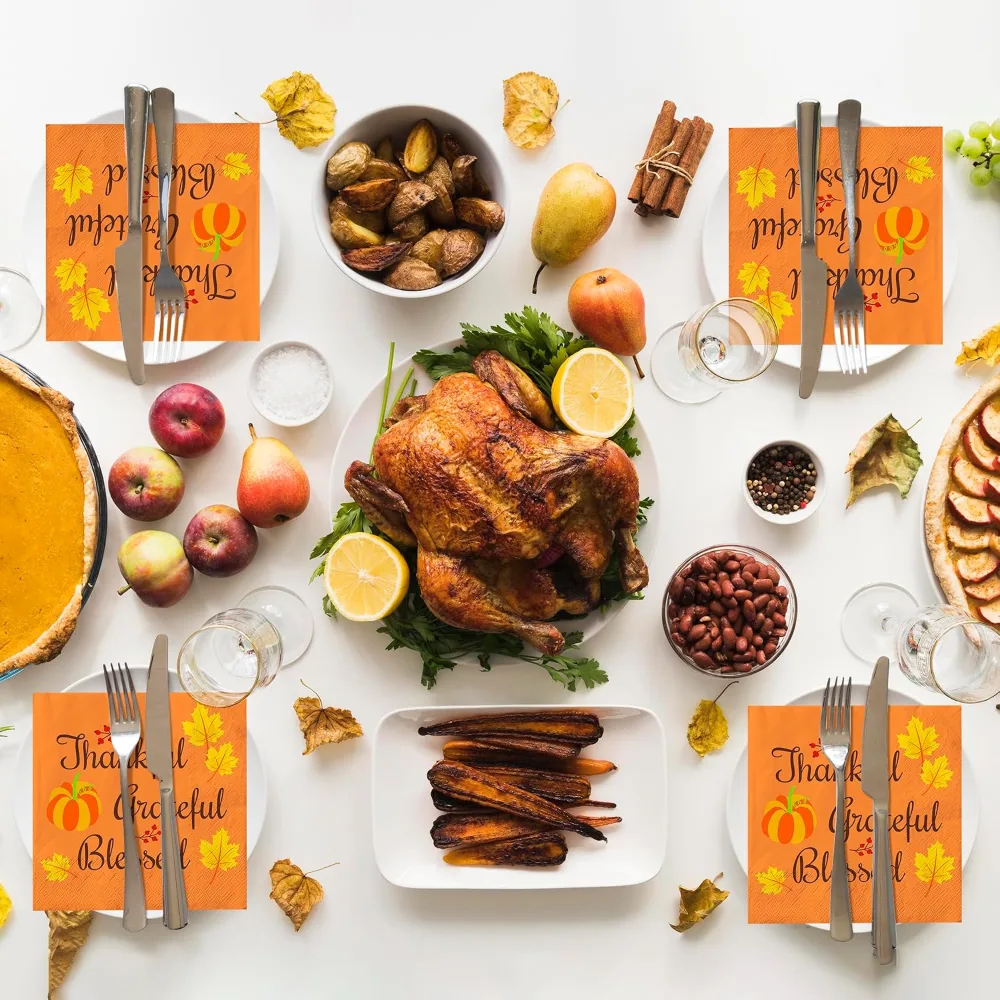
The measurement everything else follows from
The most returned item in seasonal linen is a cloth that turned out an inch short, and it is entirely avoidable. Every size in this category follows from two measurements of your own table plus one decision about how far the fabric should hang.
Tablecloths
Measure the length and the width. Add twice your chosen drop to each. The drop is how far the cloth hangs over the edge:
- 6 inches. Casual, and it keeps the cloth clear of laps and chair arms.
- 8 inches. The everyday default, and what most stocked sizes assume.
- 12 inches. Formal, and it reaches roughly to the knee of a seated guest.
A 72 by 40 inch table with an 8-inch drop therefore wants about 88 by 56 inches of cloth. Round up rather than down every time.
Runners
A runner should overhang each end by about six inches, so add roughly twelve inches to the table length. Standard runner width is 13 to 14 inches, sized to leave room for place settings on both sides. On a round table a runner is usually replaced by a centre square, or by nothing.
Seating, which is the question actually being asked
Most people are not really asking what size cloth they need. They are asking whether the table will take ten people. The arithmetic for that is 24 inches of table edge per adult, plus room at the ends.
| Table | Comfortable | Possible | Cloth for an 8-inch drop |
|---|---|---|---|
| 48 × 36 in, round or square | 4 | 5 | About 64 × 52 in |
| 60 × 36 in | 6 | 6 | About 76 × 52 in |
| 72 × 40 in, the common rectangle | 6 | 8 | About 88 × 56 in |
| 84 × 42 in | 8 | 10 | About 100 × 58 in |
| 96 × 42 in | 10 | 12 | About 112 × 58 in |
| Two 72-inch tables pushed together | 12 | 16 | Two cloths, overlapped at the join |
The table size guide has the whole method, and the calculator on the home page will do the arithmetic from your two measurements. It is thirty seconds of work that removes the single most common reason for sending seasonal linen back.
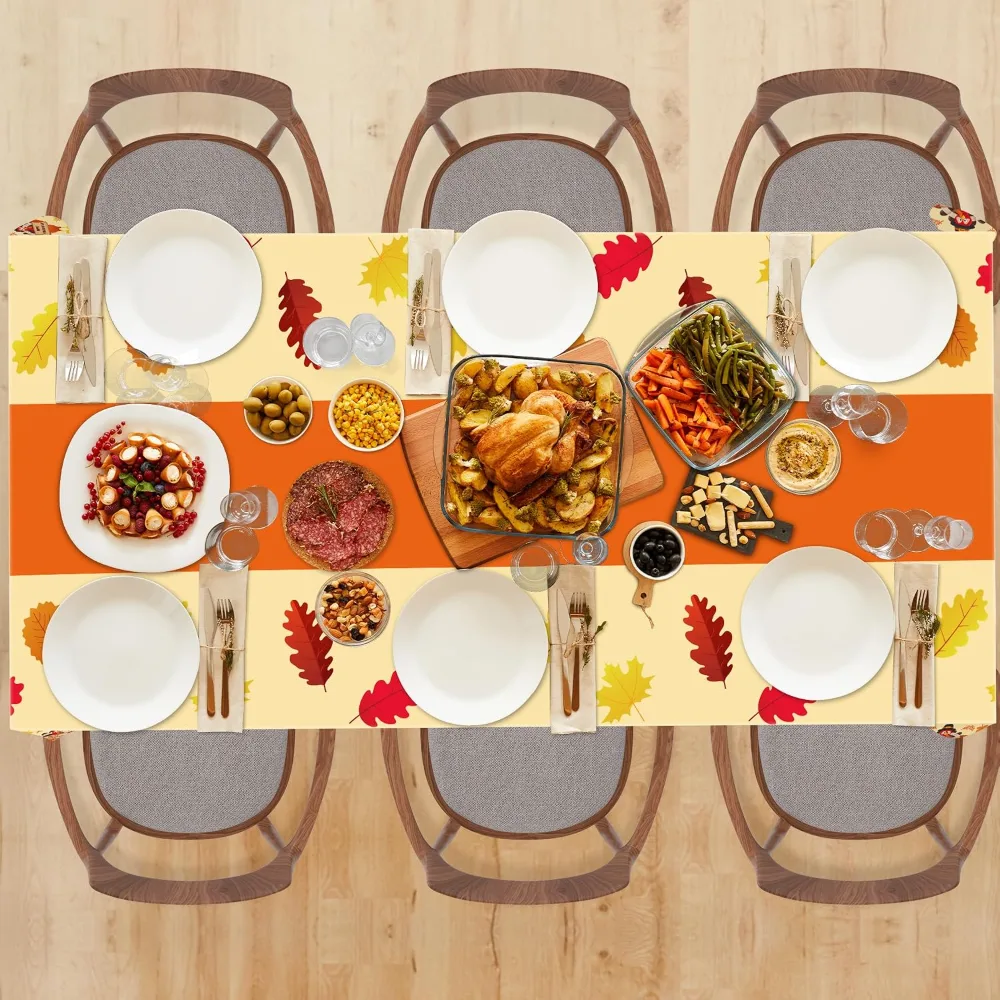
Disposable or fabric, decided honestly
This is treated as a question of taste and it is really a question of who is washing up. Both answers are correct in different households.
| Printed plastic cover | Printed polyester cloth | |
|---|---|---|
| Cost per use | Low the first time, then repeated every year | Higher once, then close to zero |
| After the meal | Folded up and binned with the mess inside it | Cold wash, gentle cycle, no bleach, dry low |
| Cranberry sauce | Irrelevant | Comes out if treated the same evening. Sets if not |
| Children | The right answer | Workable with a colouring cover over the children's end |
| Photographs | Reads as plastic in raking light from a window | Reads as fabric, drapes properly at the corners |
| Multiple tables | Cheap enough to cover three tables | Expensive to buy three |
| Outdoors | Needs clips, or the first gust takes it | Heavy enough to stay put |
The split most households land on: a fabric cloth or a runner for the adult table, plastic for the buffet and the children's table. That is also why the range sells both, and why multi-packs of plastic covers exist at all.

Six covers in a pack is the unit for a household hosting the whole family across several tables, or for a hall.

The single most useful purchase in the category: a runner over bare wood changes the room in ten seconds and washes afterwards.
The material section of the size guide covers burlap and linen-look fabrics as well, which behave differently from both of the above and should be spot-cleaned rather than washed.
The centrepiece problem is height
Almost every centrepiece failure is the same failure. It is too tall, and the two people either side of it spend the meal talking around it.
The working rule is twelve inches. Anything in the middle of a dining table should sit below about twelve inches high, which is under the eye level of a seated adult, or else be tall and thin enough to see past, like a single candlestick. Everything between those two states blocks a conversation.
Anything in the middle of a dining table sits below twelve inches, or is thin enough to see past. Everything between those two states blocks a conversation.The twelve-inch ceiling
That rule quietly explains the shape of the whole category. Laid-flat garlands, low honeycomb pieces, scattered leaves and grouped small objects all exist because a table centre has a ceiling. A large floral arrangement belongs on a sideboard, where nobody is trying to see over it.

Nine honeycomb pieces that stand well under eye level and pack flat afterwards, which is the whole argument for paper centrepieces.
The other thing worth knowing: the food is a legitimate centrepiece. On a table that is under 36 inches wide there is not really room for both, and a roast bird surrounded by dishes is a better-looking centre than anything you can buy. In that case put the decoration on the vertical surface behind the table instead, which is what the banner layer is for.

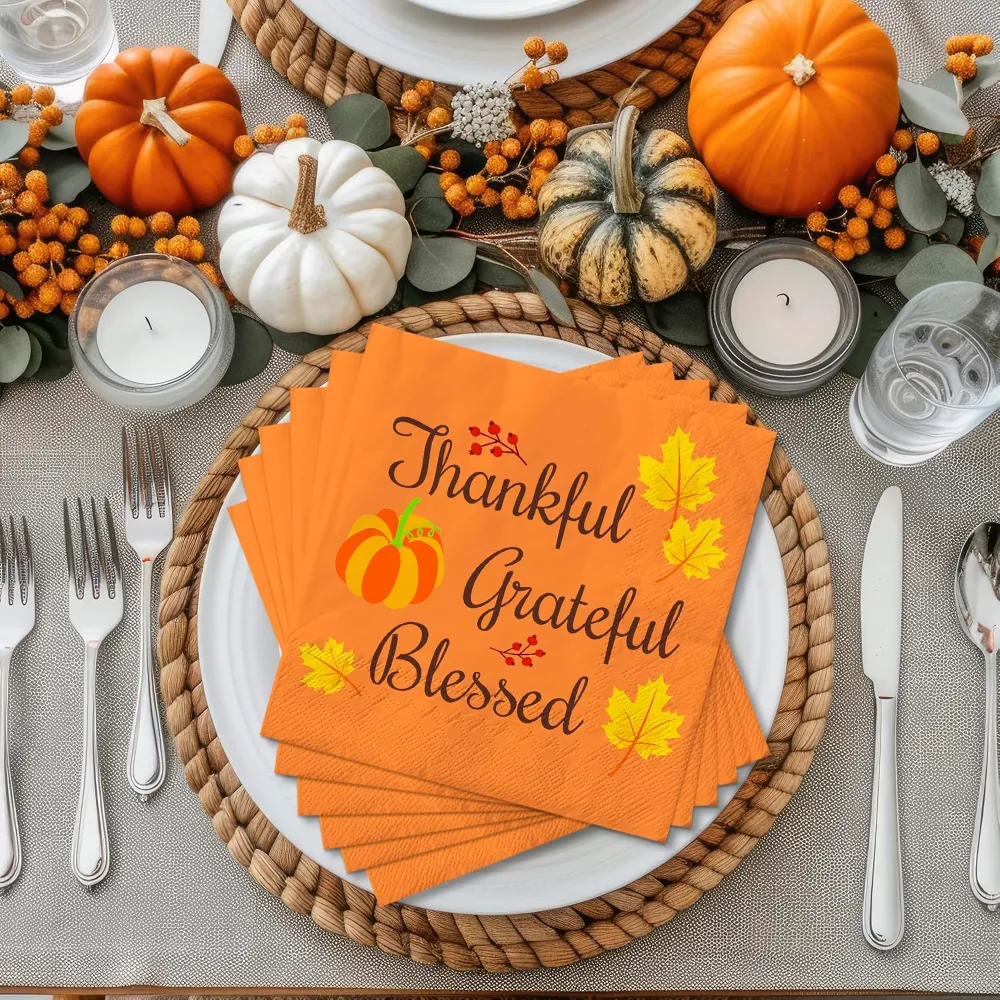
The children's end, and why it exists
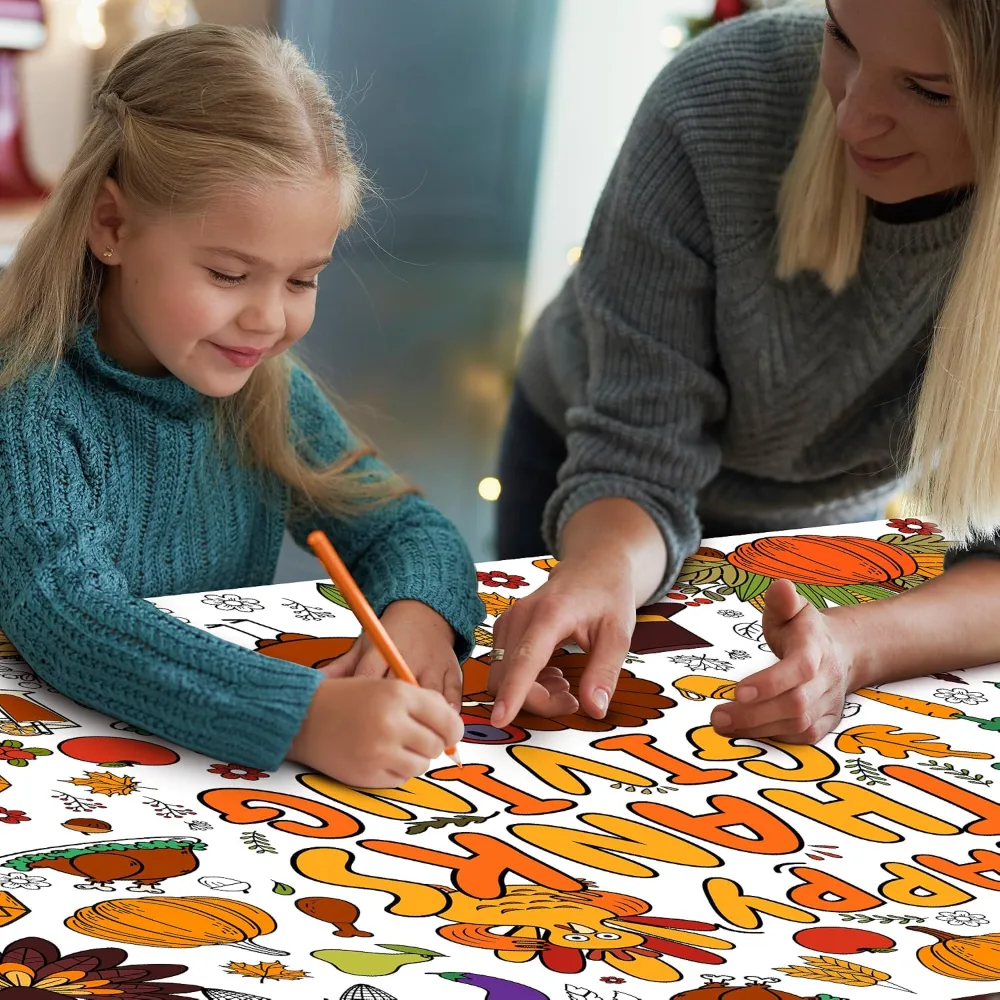
A third of the guests at a family Thanksgiving are usually under twelve, and they are being asked to sit at a table for three hours while adults talk. Everything in this part of the range exists to make that possible, and it is the reason a decoration company sells bingo cards and colouring sheets.
The colouring cover is the elegant solution because it is both layers at once. It is the tablecloth for that end of the table and it is the activity, and when the meal is over it is thrown away with whatever was spilled on it.

Three cloths with colouring posters: the adult table and the children's end covered in one purchase, which is how most households actually buy.

Bingo is the game that works across a wide age spread at once, which is exactly the problem a family table has.
Two practical notes. Put a sheet of paper or an old cloth under a colouring cover, because felt tips go through paper onto the table underneath. And buy the crayons rather than assuming there are enough in the house, since there never are on the day.
The room around the table
Guests spend three hours at the table and about an hour standing around it with a drink, and in that second hour they are looking at the walls. The room is the layer people forget, and it is the one that decides whether the photographs look like a decorated house or like a nice meal in an ordinary dining room.
Three surfaces carry it, and none of them competes with the table.
The wall behind the host's chair
This is the wall in every photograph, because it is what sits behind the food when someone stands at the other end of the table to take the picture. A banner here does more visible work than anything on the table itself. Hang it high enough that it clears the head of a standing adult, which is about six and a half feet, or it reads as a hat in every shot.

The banner that goes on the wall behind the table. It is the piece that appears in every photograph and it costs less than one place setting.
The sideboard, or wherever the food is staged
Most Thanksgivings are served from a second surface, because the table cannot hold both the settings and the dishes. That surface is where a tall arrangement belongs, since nobody is trying to see across it. It is also where the twelve-inch height rule stops applying, which makes it the place for the one large thing you actually wanted.
The doorway
A doorway is a free frame. Streamers or a simple banner across the top of the opening between the kitchen and the dining room marks the transition without taking any floor space, and it is the cheapest way to make a small flat feel like it has separate rooms.

Streamers across a doorway or behind the serving table: a large treated area for the price of a single napkin pack.
The party planner calls this the wall layer and puts it fourth, after the table itself. In a small home it is worth moving up the list, because a room without a decorated wall reads as undecorated no matter how good the table is.
Seated or buffet, and the second table
Two structural decisions make more difference to the shopping list than any product choice, and both should be made before anything is ordered.
Seated or buffet. A seated meal needs a full set of matching settings and a table big enough for the dishes, which usually means the food goes on a sideboard anyway. A buffet needs almost no settings, a much longer covered surface, and something with height in the middle of it so the food is not a flat field of trays. A household that has not decided which it is doing tends to buy for the seated version and then serve buffet, and ends up with twelve napkins nobody used.
One table or two. Once the guest count passes about ten, a second table appears somewhere: a card table at the end, the kitchen table pulled through, or the children's table in the next room. The mistake is to treat the second table as a lesser version of the first. It is a different problem with a different answer. The main table wants fabric and matching settings; the second table wants a wipeable cover and something for the people at it to do.
| Guests | Usual arrangement | What to buy |
|---|---|---|
| 4 to 6 | One table, seated | One cloth or runner, one set of settings, a banner for the wall |
| 8 to 10 | One long table, seated, food on a sideboard | A cloth to the correct size, a runner, settings, plus a cover for the sideboard |
| 12 to 16 | Two tables, or one long plus a children's end | A multi-pack of covers, one good cloth for the main table, a colouring cover for the children |
| 20 or more | Buffet, several surfaces | Multi-pack covers, banners rather than centrepieces, disposable settings |
The row that surprises people is the last one. Above about twenty guests the decorating stops being about the table entirely and becomes about the walls, because no individual surface is looked at for long enough to matter. That is the same conclusion the Halloween guide reaches about a party house, and for the same reason.
The porch, briefly
Thanksgiving is an indoor holiday, but two exterior pieces do a disproportionate amount of work because guests meet them before they meet the table.
The garden flag is the same 12 by 18 inch standard as at Halloween and fits the same stand, which means the stand is a one-time purchase and only the flag changes with the season. The porch banner is a vertical format, usually hung either side of the front door or across a porch rail, and it is the piece that turns a doorway into an entrance.

A porch banner reads from the pavement and takes about a minute to hang. It is the cheapest way to make a front door look expected.
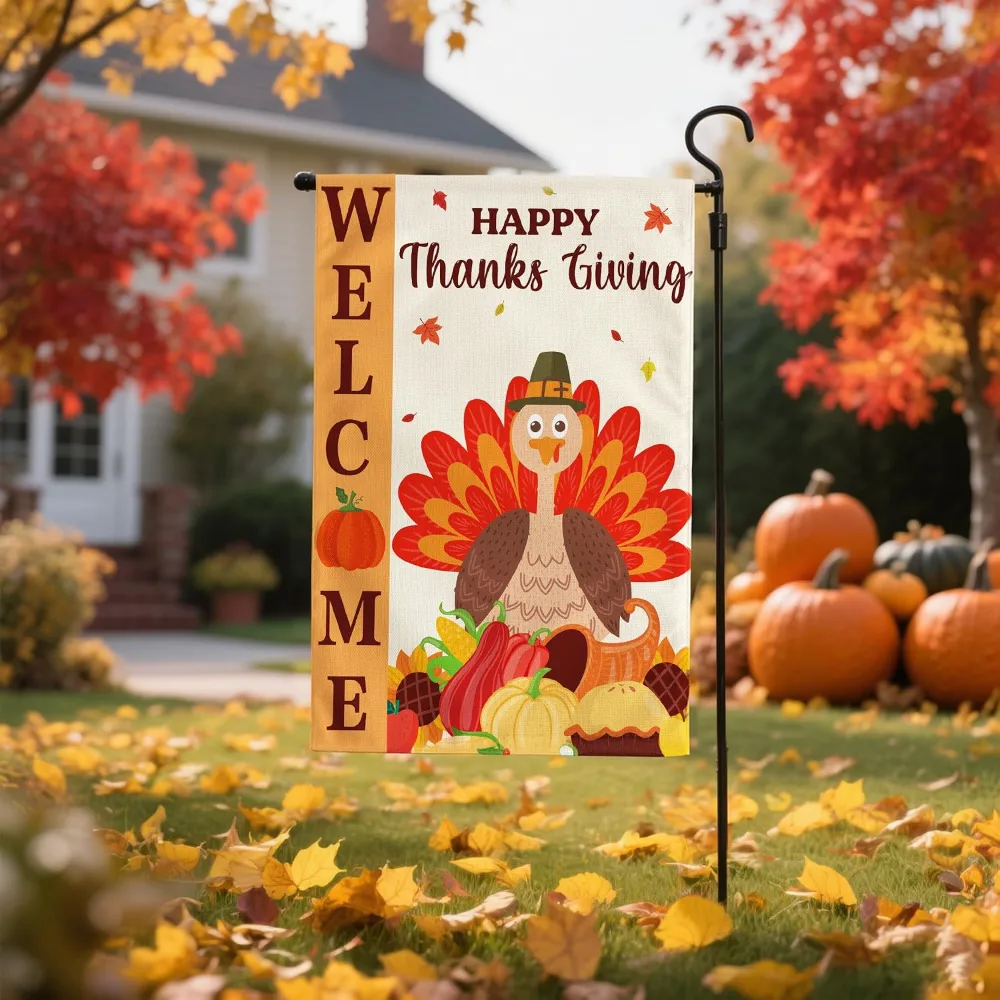
Placement is the same as at Halloween: three to six feet back from the path, on the approach side, clear of the mower line. Autumn weather is harder on outdoor pieces than October is, so bring flags in to dry rather than boxing them wet.
The colours of an American autumn table
The Thanksgiving palette is the most fixed in the calendar, which makes matching easy and makes mistakes obvious.
| Scheme | Colours | Reads as | Pairs with |
|---|---|---|---|
| Harvest | Burnt orange, maple red, amber, cream | The default, and what most printed ranges use | Almost anything on the shelf; this is the house style |
| Rustic | Kraft brown, sage, dried wheat, off-white | Quiet, farmhouse, photographs well in daylight | Burlap runners, wooden boards, real greenery |
| Deep autumn | Plum, rust, forest, brass | Evening, formal, candlelit | A dark cloth with metallic settings rather than printed ones |
Our own brand swatches were sampled from OHOME's product photography and land squarely in the first scheme: amber, pumpkin, burnt orange, maple red and sage on kraft cream. That is useful if you are buying a candle or a napkin somewhere else and want it to sit with the range rather than fight it.
The mistake to avoid is mixing the harvest scheme with the deep autumn one on the same table. They are close enough to look like an accident rather than a choice. Pick the one that matches your lighting: harvest for a daytime meal by a window, deep autumn for an evening one under lamps.
A three-week shelf
Thanksgiving has the narrowest buying window of any occasion in the calendar, and it is narrow at both ends. The shelf does not fill until Halloween has cleared, which is usually the first days of November, and it is stripped for Christmas within days of the holiday itself. In practice that is about three usable weeks.
What follows from that:
- Late October. The best moment. Thanksgiving stock is arriving while Halloween is still on the shelf, so both are available and neither is picked over.
- The first fortnight of November. The normal window, with everything in stock.
- The week of the holiday. Tablecloths in the popular sizes go first, because they are the item people discover they need on the day they lay the table.
- The weekend after. Cleared at a discount for next year. Printed indoor pieces are the right thing to buy then.
Our order calendar works this out against today's date for every occasion, and the Thanksgiving page shows how many months away the date currently is.
The three days afterwards
American Thanksgiving has a peculiarity no other occasion shares: the next holiday starts almost immediately. A great many households take the Thanksgiving decorations down on the Friday and put the Christmas ones up on the Saturday, which means the same room changes character inside forty-eight hours.
Planning for that handover is worth ten minutes in October, because it decides which pieces to buy.
- Buy the autumn pieces in the neutral register if you can. Kraft, wheat, sage and cream read as harvest through November and do not fight a red and green scheme if they are still up in the first week of December. Bright turkey prints do not have that property.
- Keep the exterior generic for longer. A plain autumn flag or a wreath without a turkey on it can go up in early October with the fall shelf and stay until the Christmas one replaces it, which is eight weeks of use out of one piece.
- Store the Thanksgiving box where you can reach it. It goes back in the loft in the same week the Christmas box comes down, so putting one behind the other is a mistake you make exactly once.
- Order both at the same time. Thanksgiving stock and Christmas stock overlap on the shelf for about a fortnight in early November, and that is the only window where both are fully available.
The Christmas guide picks the story up from there, including which of the two dinner tables the scheme should be built for.
After the meal
Thanksgiving linen has one enemy and it is cranberry. Treat it the same evening: cold water from the back of the fabric, never hot, since heat sets the pigment permanently. Grease from the bird is the opposite problem and wants warm water and detergent. Doing both at once, which is what a hot machine wash does, fixes the cranberry and lifts the grease, and you keep the stain.
Beyond that the storage rules are the same as for the rest of the range. Roll printed pieces rather than folding them, dry everything fully, one box per occasion labelled by date, and put a note inside about what you were short of this year. The care and storage page has the detail by material.
One habit worth acquiring: photograph the finished table before anyone sits down. Not for anyone else, but for you, next November, when you cannot remember which way round the runner went or how many settings the pack held.
Thanksgiving, sorted by price


The rest of the run
Samhain, guising and trunk-or-treat: where the night is actually kept, what gets decorated in each of the five zones a visitor reads, and which format does the work in each one.
Christmas: The Only Holiday That Takes a Whole HouseSix weeks, four rooms, two different dinner tables and a calendar that does not agree with itself.